

Sherry Wines boast a millennia-long history and have travelled across the world over the years. However, for many people, they remain largely unknown. The wide variety of styles, its unique nuances, and the genuine system used in their ageing can often seem difficult to comprehend.
But nothing could be further from the truth! The main challenge comes when we try to understand something by comparing it to what we already know. To understand Sherry wines, it might be best to set aside everything you know about other wines and open yourself to something new.
And this also happens when talking about ‘Soleras and Criaderas’ , the traditional system employed in the ageing of Sherry Wines.
In this article, we will explore what it is, how it works, its possible origins, and some of the tools used in this fascinating process.
Keep reading and discover all about it!
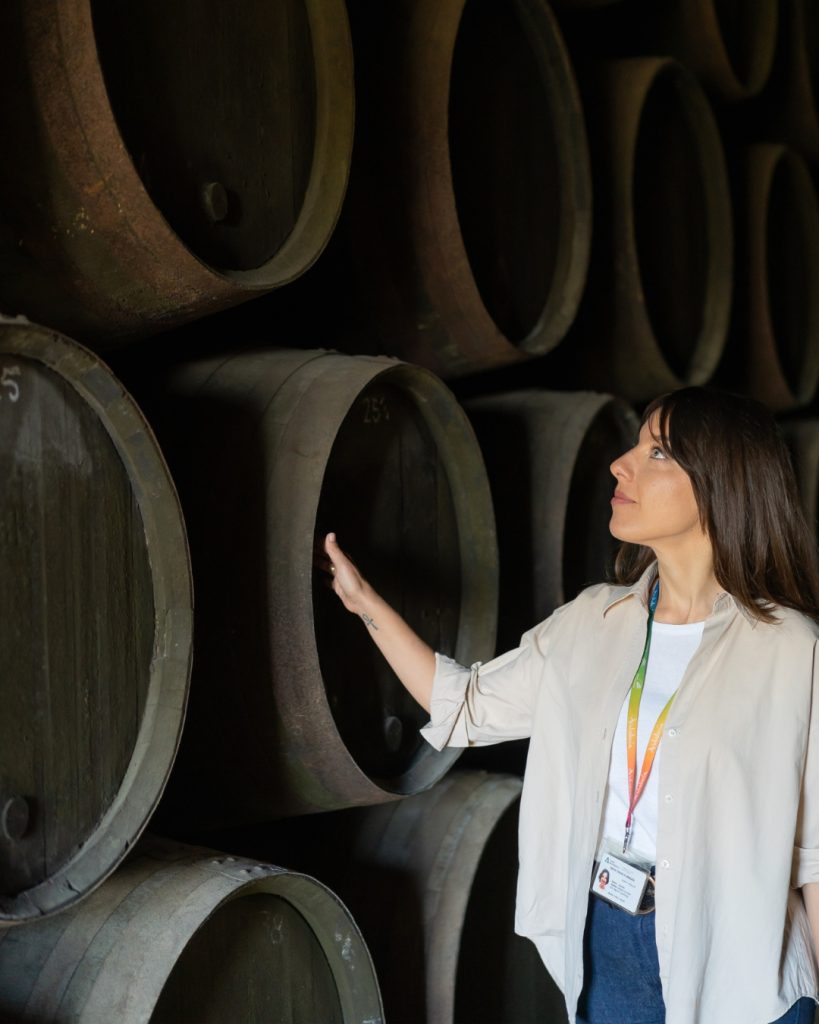
The origins of the soleras and criaderas system: how and why did it emerge?
To understand the context of the beginnings of this system, we must go back to the 17th and 18th centuries, when the demand for Sherry Wines experienced a period of growth and splendour, especially in the markets of England and the Netherlands.
At the same time, meanwhile, in the Marco de Jerez there was a conflict of interests between the producers, mostly winegrowers, who preferred to sell short-aged, lighter and pale coloured wines, and the merchants, who wanted to satisfy the market demand, that was beginning to show a preference for darker, more aged and fuller-bodied wines.
In order to protect their interests, the producers founded the Vintners’ Guild in 1733, which regulated both the production and marketing of sherry wines. The guild’s regulations limited, among other things, the ageing of wine, which made it difficult for merchants to meet the growing demand for more aged wines.
Although there is no exact information on when and where this system emerged, it is believed that the Soleras and Criaderas process began to take shape in the second half of the 18th century with the blending of wines from different vintages, originally in Sanlúcar de Barrameda. As the conflict between the vintners and the merchants grew, this system would spread to Jerez and other areas of the Region, in response to the need to adapt production to market tastes.
Following the Extractors’ Action, which took place in 1775, the Vintners’ Guild was abolished. This marked the beginning of a new era of liberalisation in the region’s wine industry, allowing a more flexible response to market demand and generalising the ageing of Sherry Wines through the Soleras and Criaderas system.
What does the soleras and criaderas system consist of?
Basic concepts to understand the system
The Soleras and Criaderas system is a dynamic method. What does this mean? Well, unlike the vintage system, in which the wine comes from a single harvest that ages statically, the soleras and criaderas method combines wines from different vintages, giving Sherry Wines a unique and homogeneous character that is maintained over the years.
To better understand how this system works, it is necessary to clarify some concepts:
Casks or ‘botas’
In the bodegas of the Sherry Region, wine is aged in american oak casks known in the region as ‘botas’.
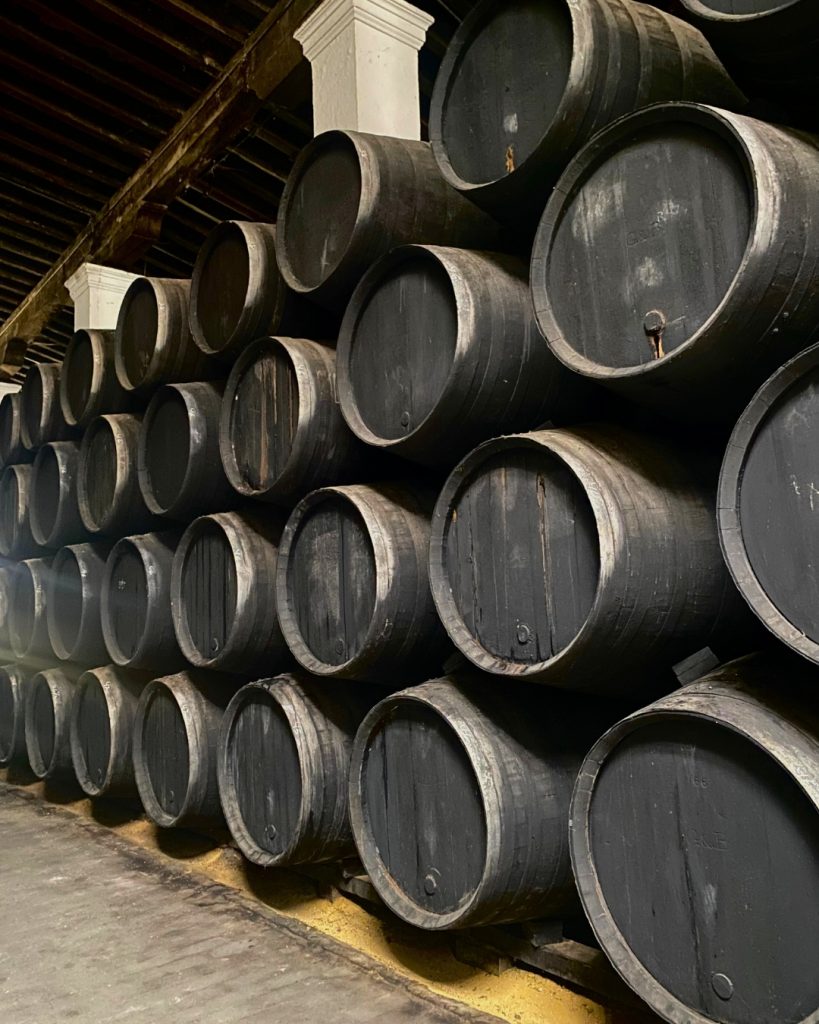
As can be seen in the image, the casks, barrels or ‘botas’ – which usually have a capacity of 600 litres – are placed in rows or scales, one on top of the other. This set of rows, from the row closest to the ground to the last row above, is called an ‘andana’. (or ‘cachón’, if the andana is small).
Soleras y Criaderas
These are the levels of the system, according to the age of the wine. The bottom row of casks, the one closest to the ground, forms the ‘solera’. The ‘solera’ contains the oldest wines of the ‘andana’.
Above the solera is the next row of casks, known as the ‘primera criadera’ (or nursery), which contains wines younger than the solera row.
Above the first criadera is the row of casks of the second criadera, which contains younger wines than those of the first criadera. And so on, until reaching the top criadera, where the youngest wines of the whole criadera are found.
Taking the image as an example, we can see four rows of casks where we can distinguish the solera, which is the row closest to the ground and contains the oldest wines, and then the first, second and third criadera.
Sobretablas
According to the glossary of sherry.wine, it is the proper name of the must that has just been fortified for various purposes, and which from then on is referred to as wine. In other words, it is a phase of the wine of the last vintage and already fortified, which rests before it becomes part of the soleras and criaderas system. This phase is particularly common in biologically aged wines.
How the ‘Soleras and Criaderas’ system works?
At specific times of the year, the winemaking task of saca (the action of taking out the wine) is carried out. This consists, precisely, of removing a certain amount of wine from the solera (which contains the oldest wine in the cellar) for bottling and sell. The wine extracted from the solera is then replaced with the same quantity of wine from the first criadera. Through this other action, known as rocío (sprinkling), the old age and wisdom from the solera wine is nourished and enhanced with the freshness of a younger wine, while being oxygenated through contact with the air in the trasiego or movement of the wine is done with precision and careful craftsmanship.
These tasks are repeated, so that the wine from the first criadera is replenished with wine from the second criadera. And so on until the top criadera is reached, which is generally replaced with wine from the last vintage – the ‘Sobretablas’ wine, if we are referring to biologically aged wines.
This process of moving the wine from one scale to the next is known as run the scales, or ‘correr escalas’ in spanish. Although the system of soleras and criaderas is easy to explain, it requires considerable work in the bodega and, above all, a great deal of intuition and experience to determine the right moment to perform the trasiego.
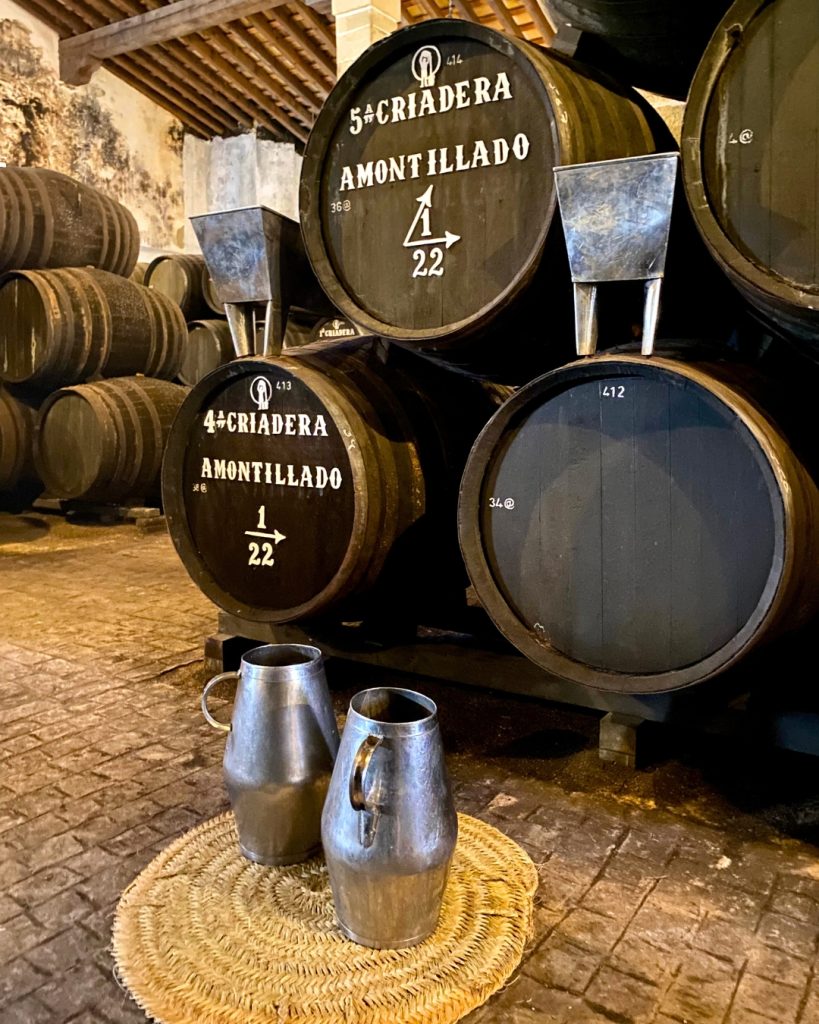
It is important to note that the casks are never moved during the trasiego process. They remain intact, so what is moved is the wine, with the help of traditional tools such as the jars, which receive the wine from the ‘sacas’, or the canoas (spanish translation for the word canoe), tools with a triangular base used as funnels to introduce the wine into the lower criaderas during the ‘rocío’ process.
It is also worth mentioning that the positioning of the solera, closer to the ground, and the last criadera in the top row is indicative. In some bodegas, one might find an andana consisting solely of solera casks, or andanas with different levels of criaderas, depending on the organisation each bodega deems optimal for the process.
Today, more advanced techniques are used to carry out these traditional tasks, such as pumps for extracting the wine or laboratory testing that allows for more precise control over the evolution of Sherry Wines.
Nonetheless, there is something that always remains unchanged: drinking a glass of wine aged using the soleras and criaderas system means drinking the history of a bodega and the result of years of work and effort from many people, both in the vineyard and the bodega.
In fact, some wineries in the Sherry Region still conserve their founding soleras — casks that contain some of the first wines produced when they began operations. These are authentic treasures, full of meaning and history, with decades, and in some cases, centuries of legacy.
Is This System Exclusive to Sherry Wines?
In addition to being a method of ageing wines to suit the preferences of the clients, the Soleras and Criaderas system ensures that wineries can maintain uniformity in the age and style of the wine that is bottled, year after year.
This system is not only used for ageing Sherry Wines, but is also applied in the ageing of Manzanilla de Sanlúcar (which has had its own Denomination of Origin since 1996), Brandy de Jerez, and Vinagres de Jerez (or Sherry Vinegars)
The Soleras and Criaderas system is also used for the ageing of wines from other regions, such as Montilla-Moriles DO and Condado de Huelva DO, and even in the ageing of spirits such as rum in some cases.
Discover the Sherry Region: Why Through ‘Soleras & Criaderas’?
With Soleras & Criaderas , I offer you the chance to immerse yourself in the authenticity of the Region, exploring its origins, historical milestones, and current developments.
The goal is not only to provide information but to transmit an identity that has been shaped, like the soleras and criaderas system, over many generations.
Discover its current context through real and personalised experiences, getting to know the essence of the destination, and contributing to responsible tourism as an active part of its evolution.
Contact me by filling in the form if you have any questions, and follow me on social media so you don’t miss any updates!
Sources used to develop this article:
Libros:
- El Jerez de los bodegueros, de Francisco Bejarano
- Jerez-Xerez-Sherish, de Manuel María González Gordon.
- The Book of Sherry Wines, de César Saldaña.
- Entre vinos, toneles y botellas, de Francisco Artola Benzón